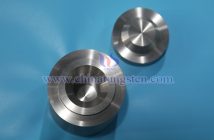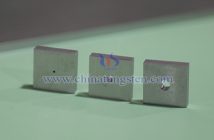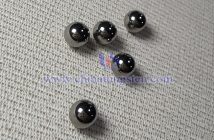
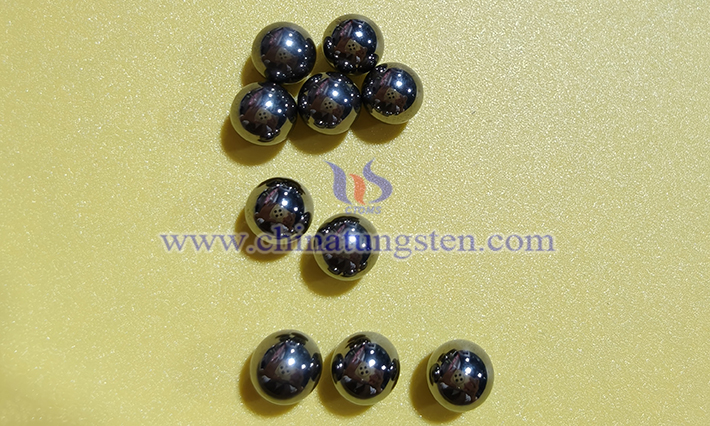
The density of tungsten beads (usually referring to high-density tungsten alloy beads), i.e., the degree to which their relative density approaches the theoretical density, is one of their most critical properties, directly affecting weight, kinetic energy, penetrating power, and crushing performance.
The theoretical density of pure tungsten is approximately 19.25-19.35 g/cm3, slightly higher for single crystals and slightly lower for polycrystalline materials due to microporosity. The density of tungsten alloy beads is generally between 17.5-18.75 g/cm3, and a density of 98%-99.8% or higher is typically required.
Main Factors Affecting the Density of Tungsten Beads
1. Tungsten Content (wt%) The higher the tungsten content, the higher the theoretical density. 90-95% W, density approximately 17.8-18.5 g/cm3. 97-99% W, density can approach 18.8-19.0 g/cm3. Fishing and hunting tungsten beads are typically controlled at 95% W or higher to achieve a density exceeding 18 g/cm3.
2. Sintering Process Parameters
Sintering Temperature: Generally 1450-1550℃ (liquid phase sintering). Too low a temperature results in insufficient densification, while too high a temperature leads to excessive grain growth and volatilization losses. The highest crushing load often occurs around 1520℃.
Sintering Time: Insufficient holding time results in more residual porosity; excessive holding time leads to grain coarsening.
Sintering Atmosphere: Hydrogen atmosphere is most common to avoid oxidation; vacuum or inert gas is also acceptable.
Heating and Cooling Rates: Too rapid a rate easily generates thermal stress cracks, affecting densification.
3. Raw Powder Quality
Tungsten Powder Purity: Higher oxygen content and impurities (such as carbon C, oxygen O, iron Fe, etc.) make densification more difficult.
Tungsten powder particle size and distribution: Ultrafine/nano powders can significantly reduce sintering temperature and improve densification, but are prone to agglomeration.
Binder phase powders (Ni, Fe, Cu): Particle size, purity, and oxygen content affect liquid phase fluidity and wettability of tungsten particles.
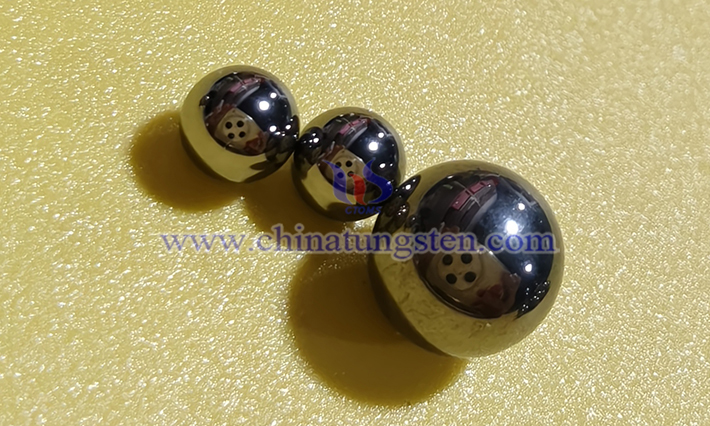
4. Forming process
Pressing pressure: Isostatic pressing (CIP) produces a more uniform density and better densification in later sintering compared to uniaxial pressing.
Green density: Higher initial density makes it easier to approach the theoretical density in the final product.
5. Post-processing
Hot isostatic pressing (HIP): Can increase density from 98% to over 99.5%, almost eliminating residual closed pores.
6. Microstructure factors
Grain size: Coarse grains reduce the adjacency of tungsten particles, resulting in decreased density and strength.
Porosity and pore type: The gradual elimination of open pores, closed pores, and micropores is part of the densification process. For every 1% increase in residual porosity, the density decreases by approximately 0.2 g/cm3.
Second phase distribution: The uniformity of the binder phase (Ni-Fe or Ni-Cu) coating the tungsten particles; a smaller wetting angle indicates better densification.