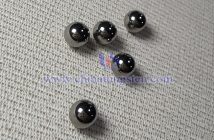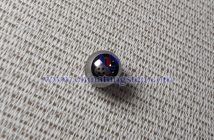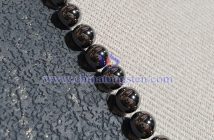
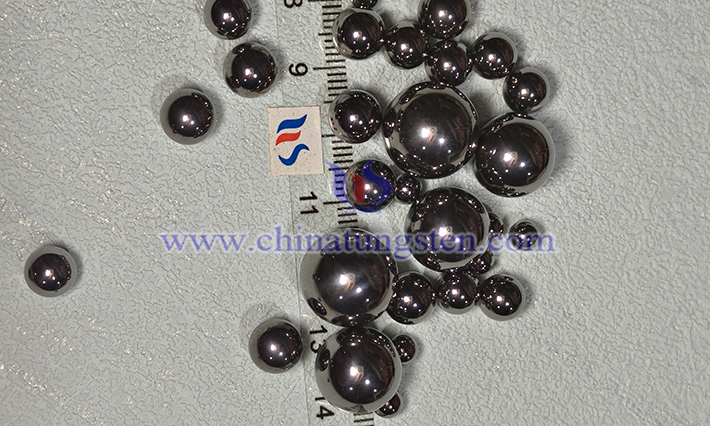
Tungsten beads, typically referring to high-density tungsten alloy beads, are commonly used in small spherical components requiring high specific gravity, wear resistance, and corrosion resistance, such as fishing weights, armor-piercing projectile cores, and counterweights. The physical and chemical properties of tungsten beads are as follows:
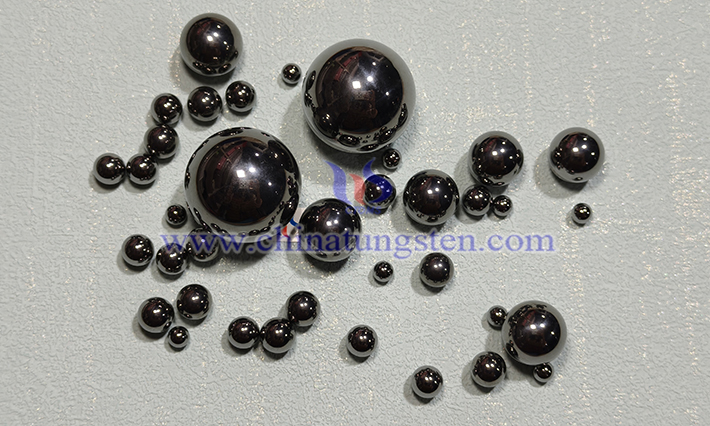
I. Physical Properties of Tungsten BeadsAppearance: Silvery-white or steel-gray metallic luster, often with a slight oxide film on the surface.
Extremely high density; pure tungsten has a density of approximately 19.25–19.35 g/cm3. Tungsten alloy beads, depending on their composition, generally range from 16.5–18.5 g/cm3, significantly higher than lead's 11.3 g/cm3.
Extremely high melting point; pure tungsten reaches approximately 3422℃, the highest among all single-metal elements.
Extremely high boiling point; approximately 5930℃.
High hardness, with a Mohs hardness of approximately 7.5 and a Vickers hardness reaching around 3430 MPa.
High strength, with tensile strength exceeding 750–1500 MPa depending on processing conditions.
High elastic modulus, with a Young's modulus of approximately 411 GPa.
Good thermal conductivity, approximately 173 W/(m·K).
Low coefficient of thermal expansion, approximately 4.5 × 10??/K.
Ductility depends on purity and processing method; pure single-crystal tungsten has better ductility, while polycrystalline tungsten is more brittle.
Good electrical conductivity, with a resistivity of approximately 5.65 μΩ·m (at 27℃).
II. Chemical Properties of Tungsten Beads Excellent chemical stability at room temperature; almost no oxidation in air and does not react with water.
Insoluble in most single inorganic acids, such as hydrochloric acid, sulfuric acid, nitric acid, and hydrofluoric acid, which only cause weak or surface corrosion when acted upon alone.
It dissolves rapidly only in a mixture of hydrofluoric acid and concentrated nitric acid (or aqua regia and hydrofluoric acid system).
At high temperatures, it readily reacts with oxygen to form tungsten trioxide (WO?).
At high temperatures, it reacts with halogens (fluorine, chlorine, bromine, iodine).
At high temperatures, it forms hard interstitial compounds with nonmetals such as carbon, nitrogen, silicon, and boron.
It does not react with hydrogen; however, the oxide can be reduced back to metallic tungsten by hydrogen at high temperatures.
It is stable to most molten alkalis, but in the presence of oxidizing agents (such as KNO?), it will be rapidly eroded to form tungstates.