The production of CTIA GROUP LTD tungsten rubber gloves mainly adopts the dip molding process. This method is based on hand-shaped molds, gradually building the thin-layer structure of the gloves by multiple immersions into the composite latex. First, the hand-shaped molds made of ceramic or metal undergo pretreatment, including cleaning, drying, and immersion in a coagulant solution to promote rapid coagulation of the latex during subsequent dipping. Next, the composite latex is prepared by uniformly mixing tungsten powder or tungsten compounds with rubber latex (such as natural latex or synthetic latex) and necessary additives (such as dispersants, vulcanizing agents, and anti-aging agents) through high-speed stirring or internal mixing, ensuring stable dispersion of tungsten particles in the emulsion without significant sedimentation. In the dipping stage, the pretreated molds are repeatedly immersed into the composite latex, with brief drying after each immersion to form multiple thin films, and the thickness is controlled by the number of dipping times and the latex concentration. The advantage of this process lies in achieving uniform distribution of tungsten filler in the rubber matrix while maintaining the flexibility and overall continuity of the gloves.
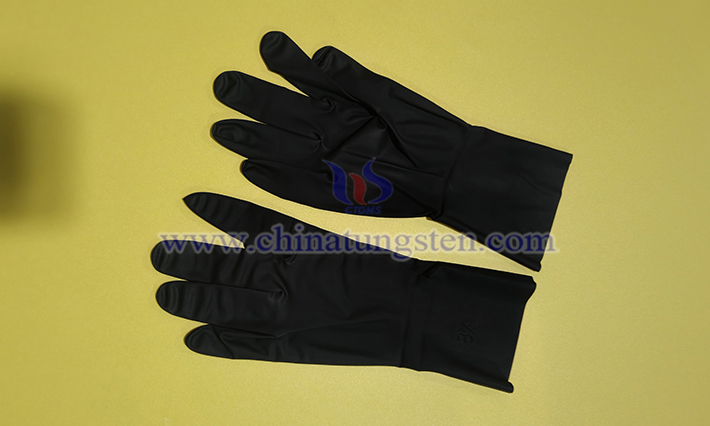
CTIA GROUP LTD tungsten rubber gloves images
After forming, vulcanization and curing is a key step. The molds with wet rubber layers are placed in a heating environment, and through controlled temperature and time, the rubber molecules undergo crosslinking to form a stable three-dimensional network structure, while the tungsten particles are fixed in the matrix to prevent migration or separation during use. The vulcanization process may use hot air ovens or steam vulcanization, selecting appropriate vulcanization systems such as sulfur-based or peroxide-based systems according to the latex type, in order to optimize the mechanical properties and durability of the material. After vulcanization is completed, post-processing steps are carried out, including hot water leaching to remove residual coagulant, soluble substances, and surface powders, followed by demolding, rinsing, drying, and surface treatment (such as applying an anti-slip layer or chlorination treatment) to enhance the comfort and service life of the gloves. Quality control runs through the entire process, including monitoring the stability of the composite latex, checking the thickness of the dipped layers, and testing the physical properties of the finished products.
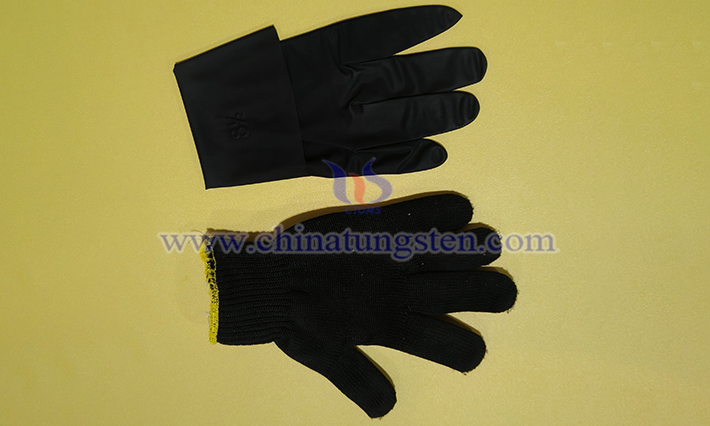
CTIA GROUP LTD tungsten rubber gloves images