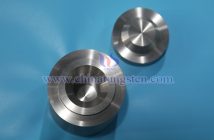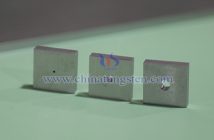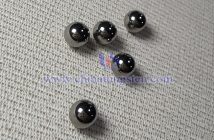
Cemented carbide rods, usually referring to solid cemented carbide rod blanks or bars, are commonly used to make cutting tools such as drill bits and end mills. The main steps in the manufacturing process of cemented carbide rods include:
Batching → Wet ball milling mixing → Spray drying granulation → Pressing forming (green compact) → Debinding → High-temperature (liquid-phase) sintering → Finishing (grinding, cutting, etc.) → Inspection and packaging
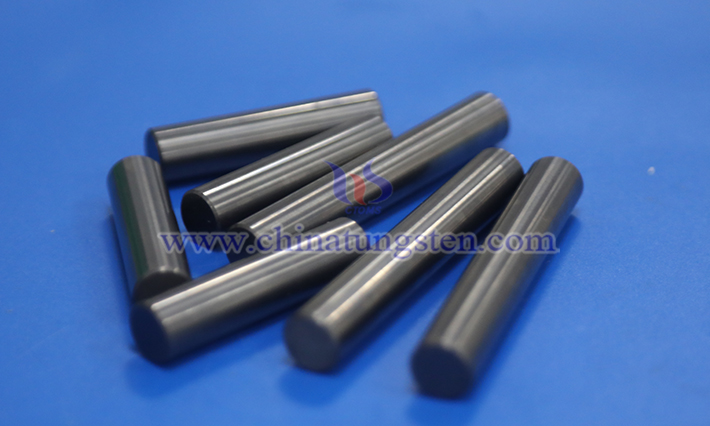
CTIA GROUP LTD Cemented Carbide Rods Pictures
1.Powder preparation and batching
Raw material powders: Use ultra-fine particle (usually submicron grade) tungsten carbide (WC) powder and cobalt (Co) powder as the main raw materials. According to performance requirements, other carbides (such as TiC, TaC, NbC, etc.) may also be added.
Formula design: According to the end-use of the product (such as cutting, wear resistance, impact toughness, etc.), precisely calculate the proportion of tungsten carbide and binder phase cobalt, as well as the amount of other additives.
Wet ball milling mixing: Put the batched powders together with organic solvents (such as alcohol or acetone) and forming agents (such as paraffin or polyvinyl alcohol) into a ball mill. Through long-time ball milling, fully mix and uniformly blend each component, and further refine the powder particles to form a uniform mixed slurry.
2.Drying and granulation
Spray drying: Pass the mixed slurry through a spray drying tower. Hot nitrogen or air instantly evaporates the solvent, resulting in dry granular powder with good flowability and uniform composition. These granules are easy for subsequent pressing forming.
3.Pressing forming
Die pressing: Load the granulated powder into a precision mold, and apply high pressure (tens to hundreds of megapascals) on a press (usually hydraulic or mechanical press) to press it into a green compact rod with certain strength and density. At this time, the rod is very brittle, like chalk.
Isostatic pressing (optional, for higher requirements): For larger sizes or rods requiring more uniform density, the die-pressed blank or powder can be placed into a flexible mold (such as a rubber sleeve), then put into an isostatic press, and isotropic ultra-high pressure is applied through a liquid medium (oil or water) to make the blank density extremely uniform.
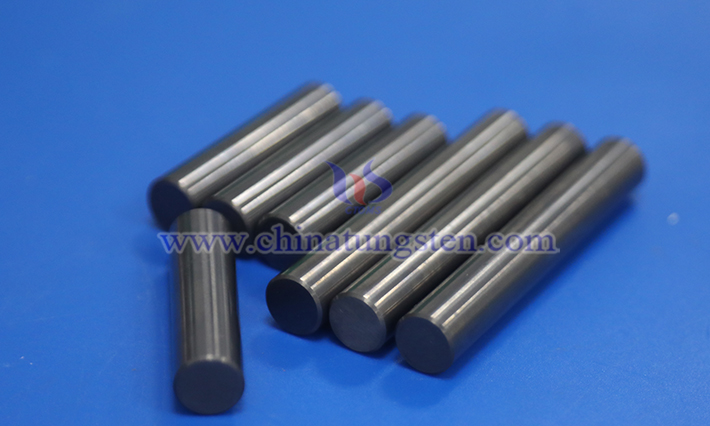
CTIA GROUP LTD Cemented Carbide Rods Pictures
4.Pre-sintering/debinding
Removal of forming agents: Place the green compact into a low-temperature sintering furnace (usually vacuum or atmosphere-protected), slowly heat to a certain temperature (such as 300-600°C), so that the forming agents (paraffin, etc.) added in step 1 are completely volatilized and decomposed and discharged. After this step, the blank has only slight strength.
5.Sintering
High-temperature sintering: This is the most critical step. Place the debound blank into a vacuum sintering furnace or low-pressure hot isostatic pressing (HIP) sintering furnace.
Process: At high temperature (usually 1300-1500°C), the binder phase cobalt melts to form a liquid phase. Through the liquid-phase sintering mechanism, tungsten carbide particles rearrange, dissolve, and precipitate in the liquid cobalt, filling the pores, causing significant shrinkage of the blank (linear shrinkage rate can reach 15-20%), and obtaining a final dense structure close to theoretical density.
HIP sintering: Applying high-pressure inert gas (such as argon) during or after sintering can effectively eliminate residual tiny pores inside the material, enabling the cemented carbide to achieve nearly 100% densification and significantly improving its mechanical properties.
6.Subsequent processing (finishing)
Although the sintered rod (as-sintered state) has achieved high hardness, the dimensional accuracy and surface finish may not meet the direct use requirements, and usually require:
Centerless grinding: Perform high-precision grinding on the outer circle of the rod to achieve precise diameter dimensions and good cylindricity.
Straightening: Straighten the bent rods.
Cutting: Cut the long rods into specific lengths according to customer requirements.
Surface treatment/coating (optional): For some high-end tool rods, surface coating (such as TiN, TiAlN, etc.) may be directly applied, so that customers only need to process the cutting edge after purchase.
7.Quality inspection
Throughout the entire production process, strict inspection is carried out on the final products, including:
Physical properties: Density, hardness (HRA).
Mechanical properties: Transverse rupture strength, fracture toughness.
Microstructure: Metallographic examination (observe WC grain size, cobalt phase distribution, porosity, etc.).
Geometric dimensions: Diameter, length, straightness, etc.