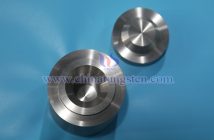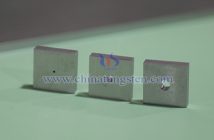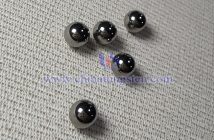
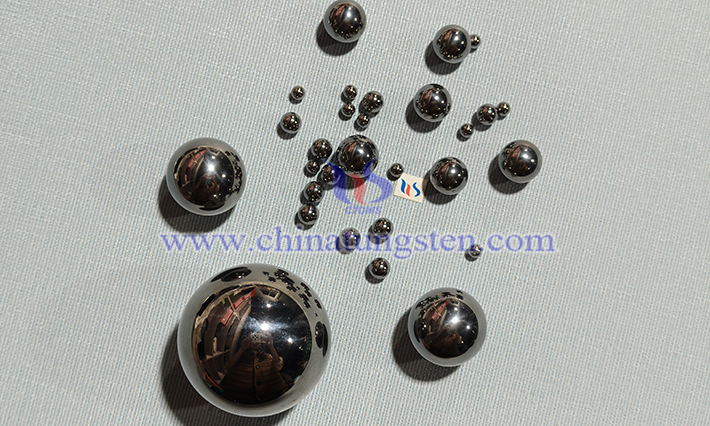
Cemented carbide calibration balls, often called probe calibration balls or standard balls, are core reference tools used for dimensional calibration and positional calibration of contact probes (probes) in high-precision measuring equipment such as coordinate measuring machines (CMMs) and machine tool probes.

1. Why choose cemented carbide as the material for calibration balls?
Cemented carbide is made from metal powders such as tungsten carbide (WC) and cobalt (Co) through powder metallurgy. It possesses hardness and wear resistance far exceeding that of tool steel. During repeated probe contact calibration, the surface of the ball is not easily worn, maintaining long-term dimensional and shape stability. It also possesses excellent rigidity and corrosion resistance, resisting deformation or dissolution in harsh environments such as impact or corrosion, ensuring absolute reliability of the measurement reference.
2. Why use cemented carbide calibration balls? The measuring machine's probe (especially the ruby tip) measures from a single point, but this point has a theoretical diameter (e.g., 2mm, 3mm, 5mm, etc.). However, in actual use, the probe may have slight eccentricity due to installation, and the probe rod may experience slight bending deformation due to its length, resulting in a micrometer-level difference between the effective diameter of the probe tip and the theoretical value. If calibration is not performed, directly measuring a workpiece with an uncalibrated probe will introduce errors into all data, leading to inaccurate results.
3. How to use cemented carbide calibration balls?
Precisely fix the cemented carbide calibration ball onto the measuring machine's worktable. The measuring machine drives the probe to touch multiple points on the surface of the calibration ball at different angles and positions (usually dozens of points need to be collected). Based on the spatial coordinates of these collected points, the measurement system software calculates the effective diameter of the calibration ball (not the theoretical diameter), the accurate position of the probe in space (including offsets in the X, Y, and Z directions), and the precise coordinates of the calibration ball's center. Subsequently, when measuring the workpiece, the measuring machine automatically compensates for all the calculated errors, thus obtaining the true dimensions of the workpiece. 4. What are the application scenarios for cemented carbide calibration balls?
Coordinate Measuring Machines (CMMs): The primary application is for probe calibration after daily startup and periodic verification.
In-line Probes on Machine Tools: Used on machining centers to calibrate contact probes mounted on the spindle for workpiece alignment and in-machine inspection.
Other Precision Measuring Instruments: Calibration of equipment such as roundness testers and profilometers.
Measurement System Performance Verification: Serving as a standard for known dimensions and shapes to evaluate the accuracy and repeatability of the entire measurement system.