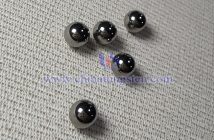
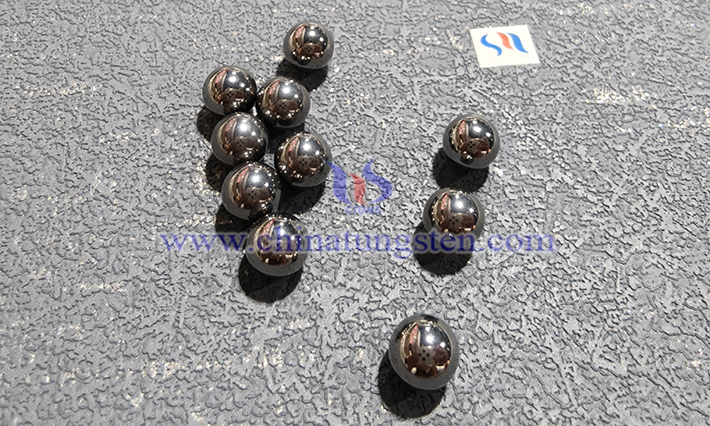
As a core control component in petroleum, chemical, and deep-sea drilling industries, the manufacturing process of carbide valve balls must balance high precision, high hardness, and adaptability to complex operating conditions. It is generally based on powder metallurgy, combined with precision forming and surface treatment technologies. The main processes of cemented carbide valve balls manufacturing are as follows:
1. Raw Material Preparation for Cemented Carbide Valve Balls
Composition Design: Tungsten carbide (WC) is used as the main phase, and cobalt (Co) is used as a binder, mixed in a specific ratio. Depending on the operating conditions, small amounts of titanium carbide (TiC) or tantalum carbide (TaC) can be added to enhance wear resistance or corrosion resistance.
Mixing and Granulation: The raw materials are pulverized to the micron level using a wet milling process. After adding a forming agent (such as paraffin wax or polyethylene glycol), the mixture is dried and sieved to produce free-flowing granules.
2. Precision Molding of Cemented Carbide Valve Balls
Cold Isostatic Pressing: Granular material is loaded into a rubber mold and uniformly pressed under high pressure (200-400MPa) to form a near-net-shape blank ball. This process eliminates internal defects and improves density uniformity.
Special Molding Technology: For large-sized valve balls (e.g., φ80mm and above), a multi-press molding method is used. The pressing angle is adjusted to form the ball in stages, avoiding cracks or uneven density caused by single pressing.
3. Vacuum Sintering of Cemented Carbide Valve Balls
Low-Temperature Pre-sintering: In a hydrogen or vacuum furnace, the forming agent is removed at 600-800℃ to prevent porosity during subsequent high-temperature sintering.
High-Temperature Sintering: The temperature is raised to 1400-1500℃, allowing the WC particles and cobalt binder to fully diffuse, forming a dense carbide structure. After sintering, the valve ball hardness can reach HRC88-92, and the flexural strength ≥2000MPa.
Pressurized sintering: Applying 10-30 MPa pressure in a pressure sintering furnace further eliminates porosity and increases density to 14.5-15.0 g/cm3.
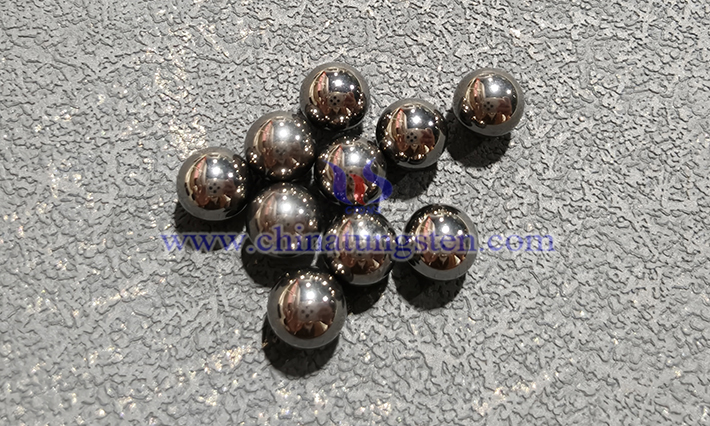
4. Precision Machining of Cemented Carbide Valve Balls
Grinding and polishing: Using a generating grinding process, the ball is gradually ground to the target dimensions and surface roughness through the relative movement of the grinding disc and the ball.
Ultra-precision machining: Polishing the sealing surface ensures a tight seal after mating with the valve seat.
5. Surface Strengthening of Cemented Carbide Valve Balls
Coating treatment: Depositing a tungsten carbide or silicon nitride (Si?N?) coating on the valve ball surface using plasma spraying or supersonic flame spraying technology, achieving a hardness of HRC70 or higher, significantly improving wear resistance.
Nitriding treatment: Gas nitriding at 500-600℃ forms a nitrided layer, improving corrosion resistance.