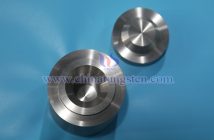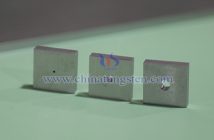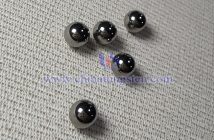
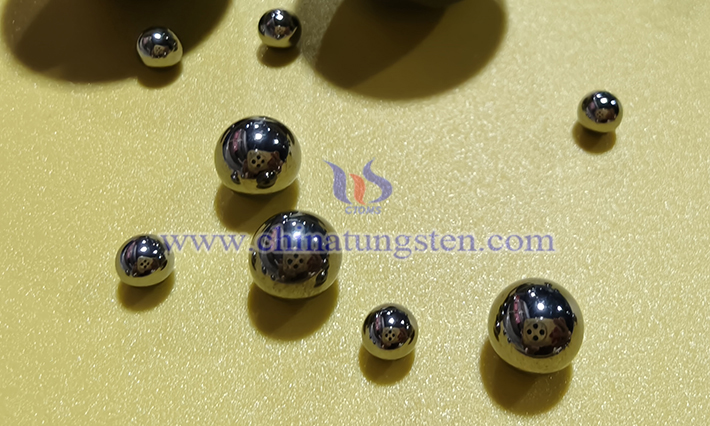
Cemented carbide valve balls use high-hardness metal carbides (such as tungsten carbide WC and titanium carbide TiC) as the matrix, and are sintered using powder metallurgy by adding metal binders such as cobalt (Co), nickel (Ni), or molybdenum (Mo). Their material structure characteristics are as follows:
I. Core Material Composition of Cemented Carbide Valve Balls
1.1 Metal Carbide Matrix
Tungsten carbide (WC): Typically accounts for over 90% (e.g., some products have WC content ≥92%), and is the main component of cemented carbide, providing high hardness (HRA ≥ 90.5) and wear resistance.
Titanium carbide (TiC): Added in some products to improve corrosion resistance and high-temperature stability.
Other carbides: Such as tantalum carbide (TaC) and niobium carbide (NbC), used to further optimize performance.
1.2 Metal Binders
Cobalt (Co): The most used binder, accounting for approximately 5%-23%, enhancing material toughness and preventing brittle fracture.
Nickel (Ni) or Molybdenum (Mo): Replaces cobalt in some products, improving corrosion resistance or high-temperature performance.
1.3 Composite Reinforcing Particles
Some high-end products incorporate composite reinforcing particles, including a core (high-entropy carbide solid solution, improving high-temperature stability), a transition layer (carbide layer, enhancing interfacial bonding), and an outer shell layer (nanocomposite structure layer, improving wear resistance and corrosion resistance).
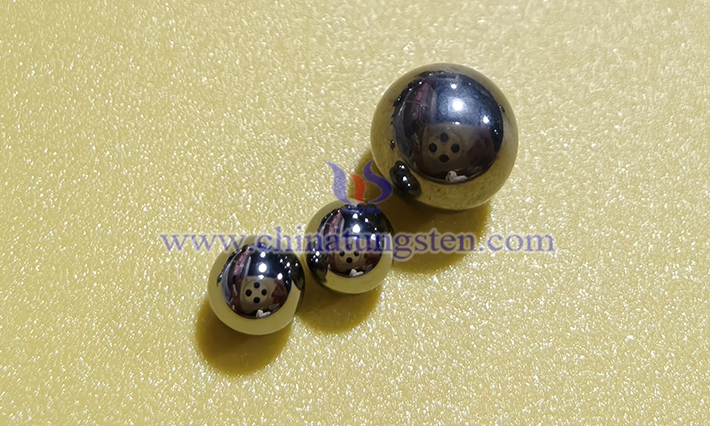
II. Microstructural Characteristics of Cemented Carbide Valve Balls
2.1 Powder Metallurgy Process
Made through steps such as powder preparation, wet grinding, mixing, molding and pressing, and vacuum sintering. The sintered material has a density of approximately 14.9 g/cm3, a uniform microstructure, and extremely low porosity.
2.2 Two-Phase Structure
Hard Phase: Metal carbide particles (such as WC) form the skeleton, providing hardness and wear resistance; Binder Phase: Metallic cobalt (Co) and other elements fill the gaps between the hard phases, forming a continuous network and imparting toughness to the material.
2.3 Surface Treatment
Some products undergo high-precision grinding and hardening treatments (such as plasma welding of cemented carbide, supersonic spraying of tungsten carbide) to improve surface smoothness and hardness.
III. Performance Advantages of Cemented Carbide Valve Balls
3.1 High Hardness and Wear Resistance
Hardness ≥90.5 HRA, wear resistance is tens to hundreds of times that of traditional steel balls, suitable for harsh working conditions such as sand and high pressure differentials.
3.2 Corrosion Resistance
The combination of the metal carbide matrix and anti-corrosion binder allows it to withstand corrosive media containing H?S, Cl?, etc.
3.3 High Temperature Stability
Some products withstand temperatures up to 650℃, suitable for high-temperature steam, hot oil, and other applications.
3.4 Sealing Performance
The bidirectional sealing design, combined with an elastic pre-tightening mechanism, achieves zero leakage (compliant with API 598/API 6D standards).
IV. Main Application Scenarios of Cemented Carbide Valve Balls
4.1 Oil and Gas Industry Deep-sea drilling, high-pressure oil and gas transmission pipelines, withstanding high pressure (nominal pressure up to 42MPa) and sand-containing media erosion.
4.2 Chemical and Power Industries High-temperature and high-pressure steam systems, corrosive media transmission pipelines, such as hydrogenation units and catalytic cracking units.
4.3 Special Operating Conditions Full-bore welded ball valves are used in underground oil and gas transmission networks; V-shaped opening structure ball valves achieve flow regulation functions.