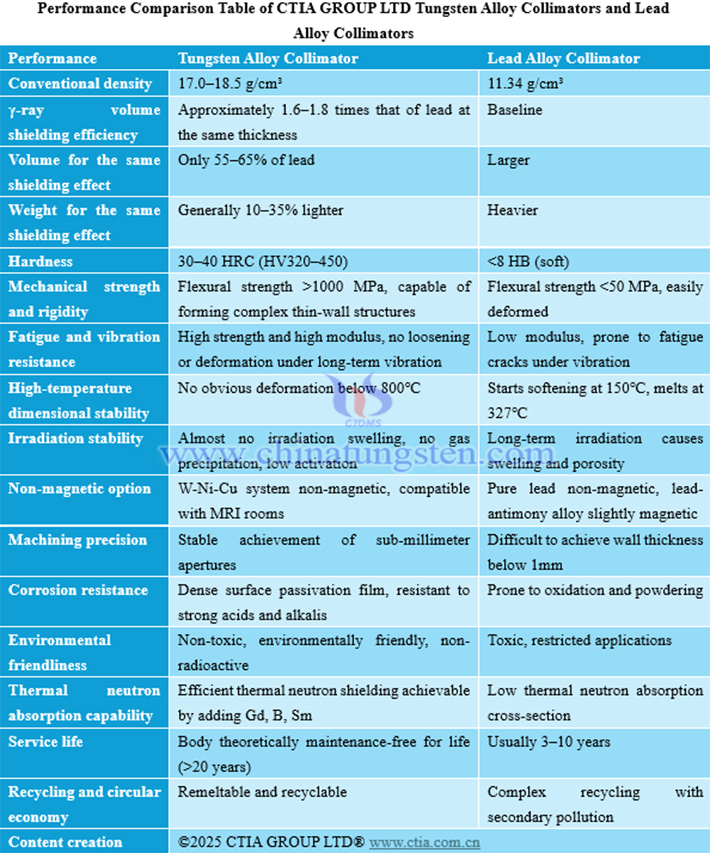
Compared with lead alloy collimators, tungsten alloy collimators (W-Ni-Fe/Cu) have higher comprehensive performance. Tungsten alloy collimators have higher density, with γ-ray shielding efficiency 1.6–1.8 times that of lead, and smaller volume for the same shielding effect. In addition, tungsten alloy collimators perform more prominently in strength, high-temperature stability, irradiation stability, machining precision, and corrosion resistance. Furthermore, CTIA GROUP LTD tungsten alloy collimators have more applications, longer service life, and are recyclable. However, it is worth noting that lead collimators have lower production costs. For any tungsten alloy collimator products, please contact CTIA GROUP LTD: [email protected], 0592-5129595. For more information on tungsten alloy shielding parts, please visit:http://www.tungsten-alloy.com/index.htm
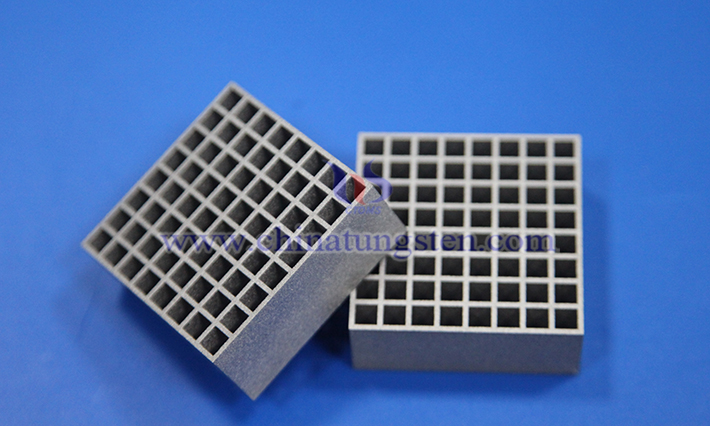
CTIA GROUP LTD tungsten alloy collimator is a key optical component made from high-tungsten-content tungsten-nickel-iron or tungsten-nickel-copper alloy, achieving directional transmission and leakage suppression of γ-rays, X-rays, and neutron beams through ray beam limiting. Common structures include elongated holes, conical holes, multi-leaf grids, or cone beam hole arrays. Tungsten alloy collimators are widely used in nuclear medicine PET-CT and SPECT high-resolution imaging, medical linear accelerator multi-leaf collimators (MLC) for intensity-modulated radiotherapy, cone/fan beam collimation in high-energy industrial CT and cargo security inspection systems, nuclear instrument spectrometers, and neutron scattering devices.
Lead alloy collimator (lead collimator) is a traditional ray beam limiting device with pure lead (≥99.99%) or lead-antimony (antimony content 1–5%) alloy as the main material. Its function is to process or cast regular structures on the lead base so that radiation passes only in the set direction, effectively suppressing scattered and side-leakage radiation to define imaging field of view or treatment field. Lead collimators were once widely used in early nuclear medicine SPECT, gamma cameras low-to-medium energy collimators (99mTc, 131I), conventional medical X-ray machines and CT pre-collimators and anti-scatter grids, industrial flaw detection and level gauge simple collimators, as well as low-cost security inspection and scientific research instruments. However, due to defects such as low density, poor strength, easy creep deformation, irradiation swelling, severe decontamination powdering, and strict restrictions on lead-containing characteristics by hazardous waste regulations in various countries, they have basically been replaced by tungsten alloy collimators in newly built high-end PET-CT, SPECT, radiotherapy accelerators, industrial high-energy CT and other equipment.