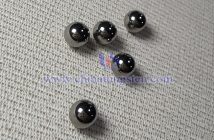
The production of tungsten carbide balls involves multiple precision processes, requiring equipment covering raw material processing, forming, sintering, and post-processing. The following are key pieces of equipment and their functions:
I. Raw Material Processing Equipment
1. Ball Mill:
Function: Mixes and refines raw materials such as tungsten carbide (WC) powder and cobalt (Co) powder to micron-sized particles, ensuring uniform composition.
Types: Includes rolling ball mills and stirred ball mills. Rolling ball mills use high-speed tumbling of the abrasive and test material within a grinding jar to generate strong pressure and friction, impacting, crushing, and shearing the material, thereby crushing and grinding it. Stirring ball mills use a stirring shaft to drive the grinding body at high speed to achieve material grinding. Material: The ball mill drum is preferably lined with carbide, and the grinding media are typically carbide balls to improve wear resistance and service life.
2. Spray Dryer:
Purpose: Spray-dries the milled slurry to produce hollow spherical particles, improving powder flowability and facilitating subsequent pressing and molding.
Advantages: Short production cycle, high production capacity, high recovery rate, and superior particle uniformity compared to vacuum drying.

II. Molding Equipment
1. Powder Servo Molding Machine:
Purpose: Presses the dried powder into desired shapes, such as spheres and cylinders.
Technical Features: Utilizing integrated mechanical, electrical, pneumatic, and instrumentation control and servo drive technology, this powder molding machine utilizes a servo motor to drive the lead screw to move the upper punch, die, and lower punch up and down. It features high intelligence, automatic pressure monitoring, a high safety factor, a simple structure, easy operation, and simple maintenance.
Mold Frame Structure: It supports a variety of mold frame configurations, including top-down-one, top-down-two, top-down-three, top-down-two, top-down-three, and top-down-two-four, to accommodate products of varying shapes and sizes.
2. Cold Isostatic Press:
Purpose: Performs secondary pressurization on the pressed green body to eliminate internal porosity, improve density uniformity, and reduce sintering distortion.
Pressure Range: Typically 1000 tons, suitable for products requiring high precision.
III. Sintering Equipment
1. Vacuum Sintering Furnace:
Purpose: Completes green body densification in a high-temperature vacuum environment, forming the final microstructure of the cemented carbide.
Technical Parameters: Temperature range: Typically 1350°C-1470°C (depending on the grade), vacuum level ≤10?3 Pa, preventing oxidation and promoting densification.
Advantage: Compared to hydrogen sintering, this method reduces graphite inclusions, improving alloy hardness and cutting durability.
2. Hot Isostatic Press:
Purpose: Uses high-pressure gas (such as argon) to apply isotropic pressure to the sintered body, further eliminating internal defects and improving material properties.
Applications: High-end cemented carbide products, such as high-precision cutting tools and wear-resistant parts.

IV. Post-Processing Equipment
1. Surface Grinder/Internal/External Cylindrical Grinder:
Purpose: Precision-machines sintered carbide balls to achieve the required dimensional accuracy and surface roughness.
Technical Parameters: Machining accuracy up to ±0.001mm, surface roughness Ra ≤ 0.063μm.
2. Ultrasonic Cleaner:
Purpose: Removes abrasives, oil, and other impurities left over from the machining process to ensure product cleanliness.
V. Auxiliary Equipment
1. Mixer:
Purpose: Uniformly blends raw material powders of different compositions to ensure chemical consistency.
Types: Includes V-type mixers, three-dimensional motion mixers, etc.
2. Screening Machine:
Purpose: Classifies raw material powders to control particle size distribution, which impacts final product performance.
3. Analytical Testing Equipment:
Includes metallographic microscopes, hardness testers, X-ray diffractometers, etc., used to test alloy microstructure, hardness, and other performance indicators.