With the rapid development of 5G communication technology, the number of base stations and power density have increased significantly, especially in the high-frequency millimeter wave band, and the power loss of radio frequency (RF) modules has increased significantly. Because RF power amplifier chips generate a lot of heat during operation, if the heat is not dissipated properly, it may lead to degraded device performance, signal distortion, and even shortened equipment life.
Therefore, how to effectively manage heat has become a key challenge in the design of 5G base stations. Molybdenum-copper (Mo-Cu) alloys play an important role in the thermal management of RF modules in 5G base stations due to their excellent thermal conductivity, low coefficient of thermal expansion (CTE) and high stability.
The RF front-end of 5G base stations mainly includes key components such as power amplifiers (PAs), filters, and antennas, among which power amplifiers are the main heat sources. Compared with 4G, the RF module of 5G base station faces more stringent thermal challenges:
1. High power density
The transmission power of 5G base stations has been greatly improved, and the power density of power amplifier chips in millimeter wave frequency bands (such as 28GHz and 39GHz) far exceeds that of 4G, which puts forward higher requirements for heat dissipation materials.
2. High-frequency working environment
High-frequency circuits are sensitive to temperature changes, and too high a temperature can affect RF signal stability and even cause gain drift and affect base station coverage.
3. Miniaturization and lightweight design
The use of massive MIMO (Massive MIMO) technology in 5G base stations has increased the number of antennas and the miniaturization of module design, making effective thermal design more important.
4. Long-term reliability requirements
5G base stations need to operate for a long time in harsh environments such as high temperature, high humidity, and sandstorms, and the heat dissipation materials must have excellent durability and stability.
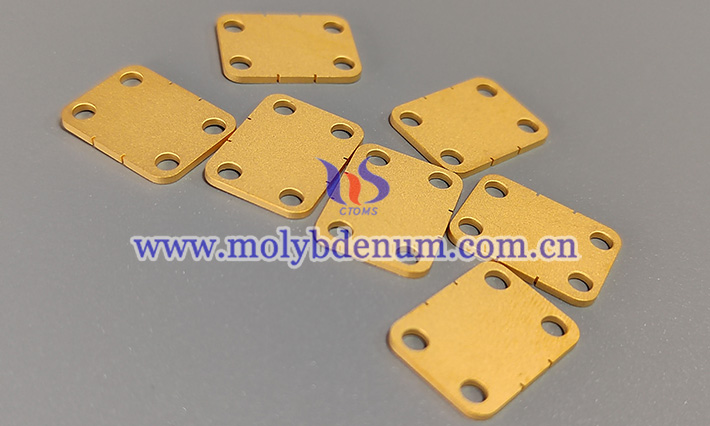
Application of molybdenum-copper alloy in RF module of 5G base station
1.Radio Frequency Power Amplifier (RF PA) Substrate
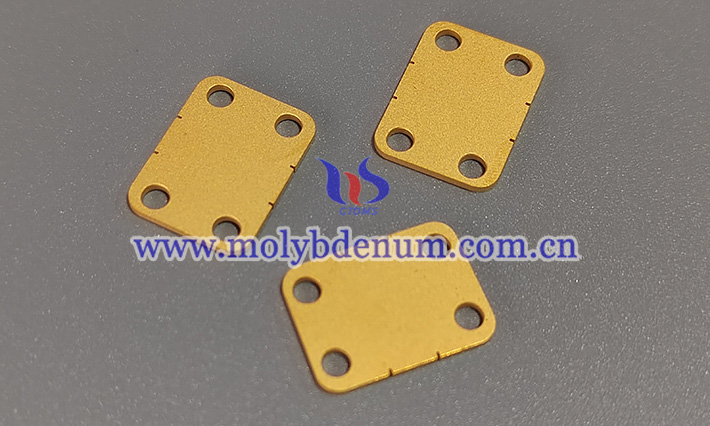
The working temperature of RF power amplifier chips (such as GaN, SiC) can reach 150-200°C, and if the heat dissipation is not timely, it will affect the performance of the power amplifier. Mo-Cu substrates have high thermal conductivity and low CTE matching, and can be used as thermal management substrates for RF chips to improve heat dissipation efficiency and enhance system reliability.
2.Heat Spreader
Due to the high integration of 5G base station modules and the concentration of heat, Mo-Cu alloy can be used as a thermal diffuser to evenly distribute heat to a larger area, optimize the heat dissipation path, and prevent local overheating.
3. Antenna array packaging
The packaging of 5G millimeter wave antenna arrays requires light weight, high thermal conductivity, and low thermal expansion, and the characteristics of Mo-Cu alloy make it an ideal antenna packaging material, which helps to improve the stability and signal transmission quality of base stations.
4.Lead Frame
Mo-Cu alloy can be used as a lead frame for 5G base station power modules to improve electrical conductivity and mechanical strength, while optimizing heat dissipation performance, reducing parasitic inductance, and improving system efficiency.